Skid steer loaders for tight sites and fast turnaround
A skid steer loader is a compact machine with a short wheelbase, four wheel drive and independent wheel control on each side. That setup lets it spin in a very small area, which is useful on construction sites in Durban, yard clean-ups in Jet Park and maintenance work in city depots where space is tight. If you need a machine that can load, grade, lift and shift material without needing a big turning circle, this is the right class of equipment.
These loaders are commonly used with buckets, pallet forks, augers, trenchers and sweepers. The quick-attach system means one operator can change tools in minutes and keep moving, even when load-shedding or weather interrupts a day’s plan.
- Compact footprint for confined work areas
- Short turning radius for yards, workshops and inner-site access
- Compatible with a wide range of attachments
- Useful for loading, grading, backfilling and site clean-up
Common sizes, lift paths and power options
Skid steer loaders are available in small, medium and larger compact frames. Small units are often chosen for landscaping, municipal maintenance and indoor or low-clearance work. Mid-size machines suit general contracting, agriculture and warehouse yards. Larger units are better for heavier bucket work, quarry support and frequent material movement on rough ground.
When ordering, check the lift path. Radial lift is often preferred for digging and ground-level work, while vertical lift gives better reach for loading trucks and stacking pallets. Power options usually include diesel engines for outdoor use and, in some cases, electric drive for enclosed areas where emissions and noise must be kept low. For coastal work in Paarden Eiland or Durban harbour, corrosion protection and sealed electrics should be specified early, otherwise the salt air will shorten service life.
- Operating weight: about 1,500 kg to 4,500 kg depending on class
- Rated operating capacity: about 400 kg to 1,500 kg
- Engine power: about 40 hp to 100 hp
- Hydraulic flow: standard flow or high flow for heavier attachments
Where skid steers are most useful in South Africa
In South African conditions, skid steers are a strong fit for contractor yards, road repair teams, farms, factories and plant maintenance crews. They work well on uneven terrain, around parked vehicles and in spaces where a front loader or telehandler would be too large. In the Durban harbour corridor, they are often used for cargo handling support, bagged material movement and yard clean-up. In Johannesburg and Cape Town, they also suit depot work, waste handling and property maintenance.
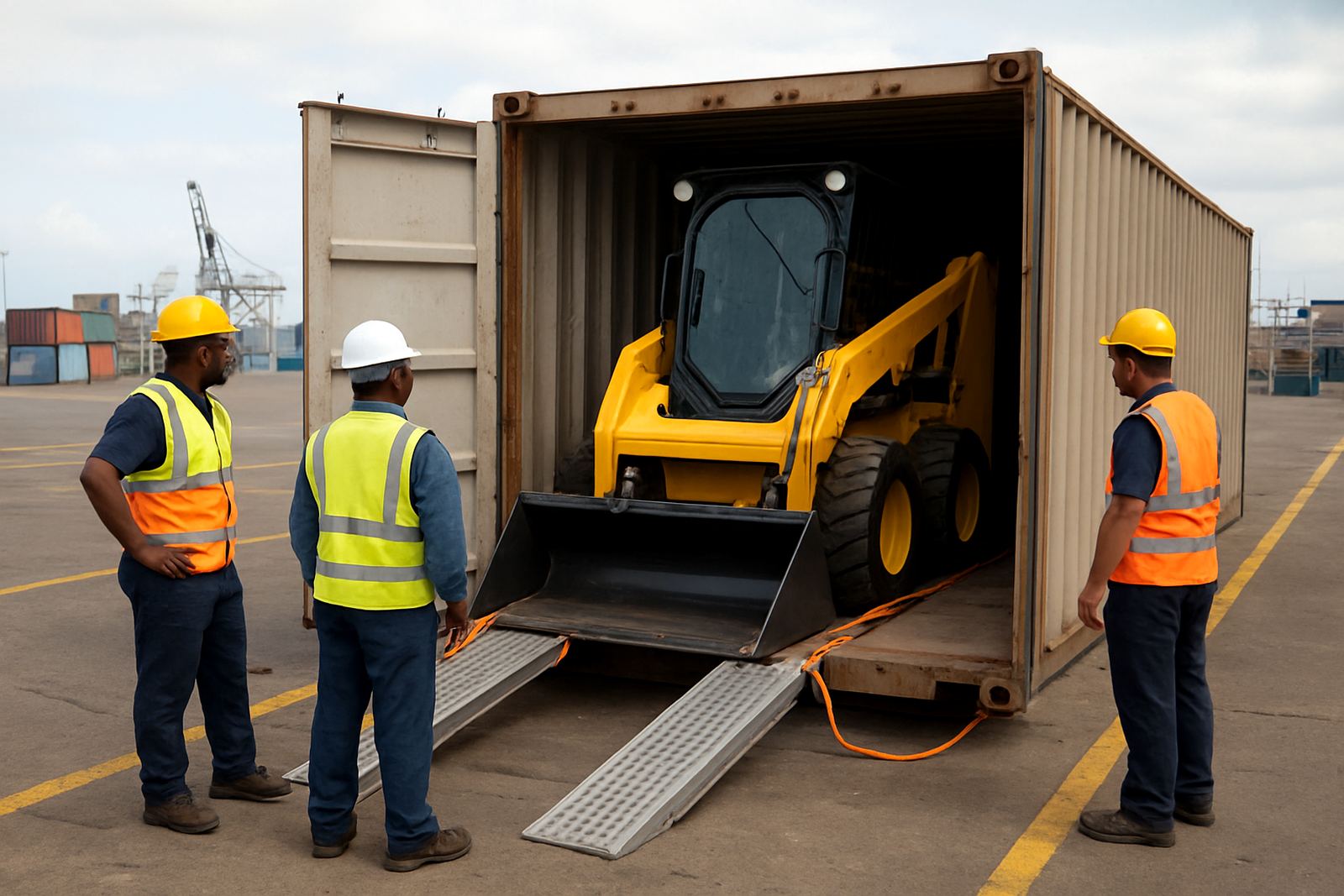
They are not ideal for long-distance travel between sites, so most buyers pair the machine with a low-bed, flatbed truck or enclosed transport for safety. If the machine will move between locations in Umbilo, Springfield Park and City Deep, plan for tie-down points, width limits and route access before dispatch.
- Construction and civil contracting
- Logistics yards and warehouse support
- Fleet depots and municipal maintenance
- Agricultural loading and feed handling
Import planning, shipping and clearing through Durban, Johannesburg and Cape Town
We manage import planning from the first shipping instruction through to customs clearing, port collection and inland transport. That includes tariff classification, document checking, cargo insurance and storage if the machine arrives before the site is ready. For machines landing through Durban harbour, timing matters because port charges and collection windows can climb quickly if papers are late.
Machines Africa Hub works from Umbilo with clearing support in Johannesburg and Cape Town, so the process can be handled close to the receiving point. We also assist with bonded storage where duty payment needs to be staged, and with site offloading where the machine has to go straight into service. Our team keeps the paperwork tight, which reduces delays at the port and helps avoid extra handling fees.
- Import Planning and Shipping Coordination
- Customs Clearing and Tariff Classification
- Port Collection and Inland Transport
- Bonded Storage, Site Offloading and Document Management
Installation, power needs and site setup
Most skid steer loaders do not need a fixed installation, but the site still has to be ready. Check gate widths, ramp angles, low wires, overhead canopies and turning space at the delivery point. If the machine will work indoors or under a shed, confirm ventilation and floor loading before it arrives. For electric units, you need a proper charging point with the right supply, ventilation and lockout procedure. For diesel units, keep clean fuel, a secure storage area and a refuelling plan that suits your shift pattern.
On wet coastal sites, keep the parking area drained and wash salt off the undercarriage after work. In hot inland conditions, allow for dust protection and daily filter checks. If your site runs on generator power because of load-shedding, confirm charging or fuel requirements before the first delivery so the machine is not idle on day one.
- Check access gates, ramps and delivery offload space
- Confirm fuel type or charging supply before arrival
- Plan for ventilation where the machine works under cover
- Provide a safe parking area with drainage and security
Care, servicing and order checks before you commit
Skid steer loaders need regular servicing if you want steady output and fewer stoppages. Daily checks should cover oil levels, coolant, tyres or tracks, hydraulic hoses, quick coupler pins and bucket wear. Grease points must be done on schedule, especially on machines used for dust, demolition debris or abrasive aggregate. If the loader works near the coast, inspect exposed steel more often because rust starts sooner than most operators expect.
Before you place an order, ask for the machine serial number, year of manufacture, lift height, operating weight, tyre size, hydraulic flow and attachment compatibility. Also confirm whether the unit comes with cab protection, air conditioning, battery isolator and ROPS/FOPS protection. These details matter when the machine is going into fleet use or being registered on a controlled site.
- Daily fluid, tyre and hose checks
- Greasing and filter changes at the correct service interval
- Rust prevention for coastal operations
- Confirm attachment type and hydraulic flow before purchase
How to choose the right skid steer for your work
The right machine depends on what you lift, how often you move and how tight the site is. A contractor doing trench backfill and rubble removal may need a compact unit with good manoeuvrability. A logistics yard handling pallets and bagged goods may need more lift height and a vertical path. If you are working with attachments, high flow hydraulics may be worth the extra cost because it gives better performance on augers and sweepers.
Tell us your working area, ground conditions and the type of material you handle. We will help you match the loader to the job and arrange shipping, clearing and delivery to Durban, Springfield Park, Jet Park, City Deep or Paarden Eiland. If the job is urgent, we can also look at storage and staged release so the machine arrives when the site is ready, not days too early.
- Share the material type, weight and lift height needed
- Confirm whether the site is tight, dusty, wet or coastal
- List the attachments you plan to use
- Tell us your delivery point and offloading method
Key facts
| Machine type | Skid steer loader, compact articulated turn machine |
|---|---|
| Typical operating weight | 1,500 kg to 4,500 kg |
| Rated operating capacity | 400 kg to 1,500 kg |
| Engine power | About 40 hp to 100 hp |
| Hydraulic setup | Standard flow or high flow options |
| Common attachments | Bucket, forks, auger, trenching tool, sweeper, grapple |