
Why generator prep starts before the truck arrives
A generator is not a standard pallet load. It often carries diesel, oil, coolant, batteries and a frame that must be lifted in the correct places. If any of that is ignored, the unit can leak during transit, shift on the back of the truck, or be delayed at the port while the paperwork gets sorted out.
In Durban, where humidity and salt air can already work against metal surfaces, a generator should be made ready for shipment as soon as collection is planned. That means checking for loose fittings, cleaning any external residue and confirming whether the unit is new, used or being returned for repair. The condition at handover affects the packing method, the transport risk and the customs documents that follow.
Our team in Umbilo handles generator shipments through Durban harbour and also supports clearing counters in Johannesburg and Cape Town. We see the same pattern often: the shipping plan is sound, but the unit itself was not prepped for movement. A few small checks before loading can save days later on.
Drain or stabilise fluids before export
Fluids are the first point of attention. Diesel tanks, engine oil and coolant all need to be assessed before shipment. Some units must travel dry, while others can move with controlled levels depending on the route, the packing method and the transport rules used by the carrier. Do not assume that a generator can be lifted and loaded with everything left as is.
For export jobs, the safest approach is to confirm the exact fluid requirement in advance, then document it clearly for the collection team and the clearing file. If a unit has leaked during storage, the drip tray, bunded area or crate floor may already be compromised. That can lead to rejected cargo at the depot or extra cleaning charges before acceptance.
- Check fuel tank status and confirm if it must be drained completely.
- Inspect oil and coolant levels, then seal all caps properly.
- Clean any visible residue around hoses, filters and the base frame.
- Record the condition with photos before collection.
For inland transport from Jet Park or City Deep, fluid control matters just as much as for port-side cargo. A truck that is held up by a spill inspection can upset the delivery schedule for a whole site in Gauteng.
Battery isolation and electrical safety on the load
Most generators include a battery or starting system that should be isolated before movement. The battery can be disconnected, secured and in some cases removed entirely, depending on the shipment plan. That step reduces the risk of accidental start-up, arcing or damage during vibration on the road.
Loose cables are a common problem. They can rub against the frame, catch on straps, or create confusion when the unit is unpacked at site. It is better to label leads, secure terminals and keep small parts in a marked packet attached to the machine. If there is an automatic control panel, it should be protected from dust, rain and rough handling.
- Disconnect the battery and cover the terminals.
- Secure all loose cables, plugs and accessory leads.
- Protect the control panel with wrap or rigid cover.
- Keep manuals, keys and spares with the shipping file.
At coastal points like Paarden Eiland, the extra moisture means exposed terminals can corrode quickly if they are left open. That is why battery isolation is not just a safety issue, it is a delivery issue too.
Lifting points, frames and how the generator should be handled
Every generator has a preferred lifting method, usually set by the frame and the weight distribution. Forklift pockets, lifting lugs and base skids must be identified before the machine is moved. If a rigger guesses wrong, the frame can twist or the casing can crack. That becomes expensive very quickly, especially on larger units used for mining support, fleet depots or backup power at industrial sites.
Before collection, the supplier or shipper should confirm the exact mass, dimensions and centre of gravity. If the unit needs a crane, the sling points must be checked for wear and the route from loading area to truck must be clear. Site offloading also needs planning, because a generator that can be loaded by forklift may still need a crane at destination if the delivery point has limited access or uneven ground.
We often arrange machinery collection in Durban, Springfield Park and the harbour corridor where yard space is tight and vehicles must be positioned carefully. A generator can be perfectly packed, but if the lifting method is wrong the rest of the plan does not matter.
Packing for port movement and inland transport
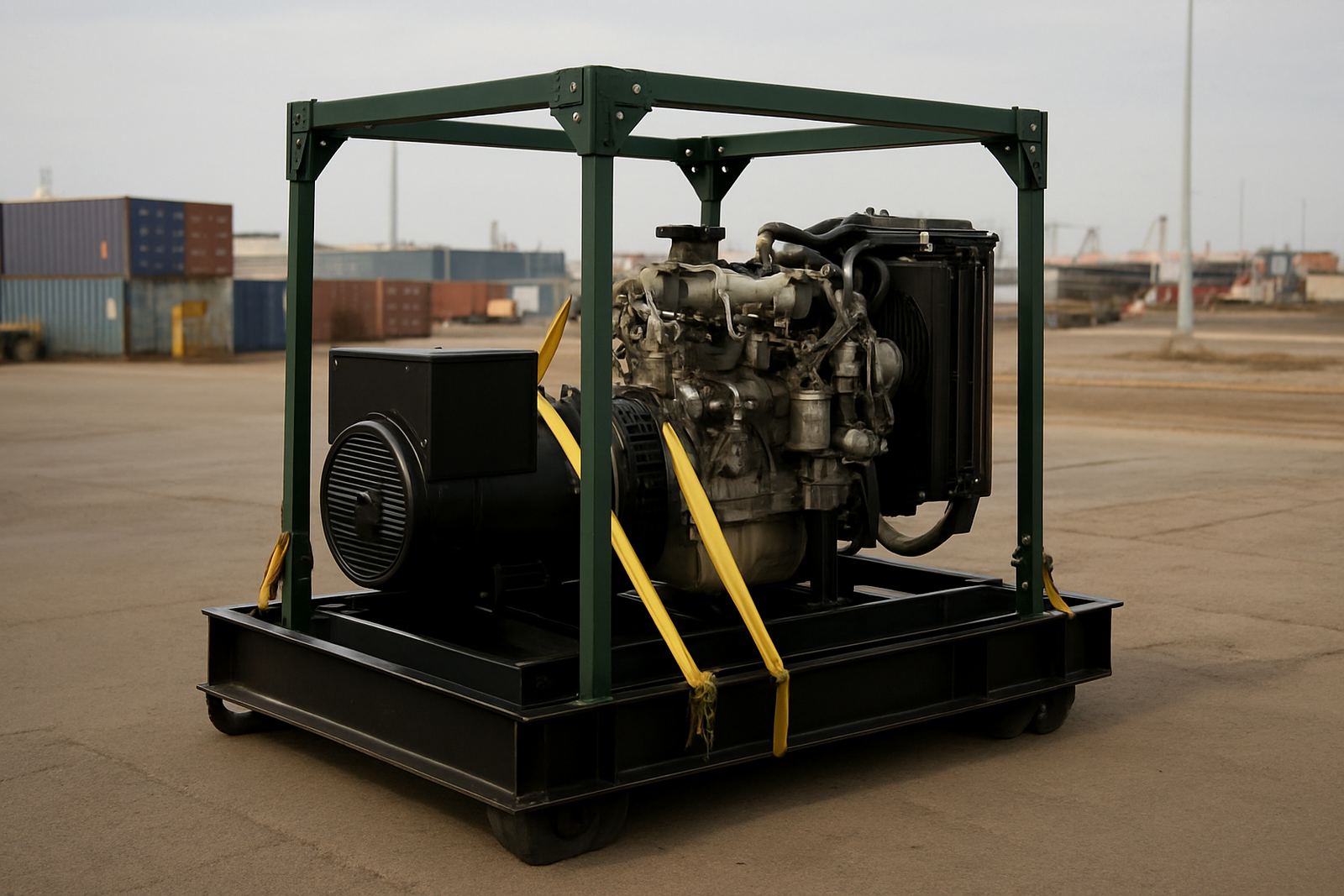
Once the unit is ready for lifting, the next step is protection during movement. Generators are usually secured on a pallet, skid or steel frame, then strapped down in a way that prevents side movement and bounce. In some cases, the machine needs shrink wrap, moisture protection or a crate, especially if it is travelling through different climates between the coast and inland.
For Durban harbour shipments, we normally look at exposure to rain, fork handling, and time in transit before vessel loading. If the cargo is going to Johannesburg first, then loaded again for export or delivery, the packing has to stand up to multiple touches. That is where bonded storage, careful document management and clear marking all help.
- Use a base strong enough for forklift tines or crane slings.
- Strap the load so the frame cannot shift on braking.
- Mark the unit with weight, lift points and orientation.
- Add moisture protection if the route includes coastal storage.
Load-shedding has made generators a regular purchase for warehouses, clinics and workshops, but that also means more units are moving at once. Good packing prevents site delays when a backup set is needed urgently and must be put into service without repair work first.
A Durban harbour example: one generator, three handovers
We recently handled a generator moving from a manufacturing site near Umbilo to Durban harbour, then onward through inland transport after clearing. The machine had a half tank of diesel, a connected battery and a few loose fittings near the base. Before loading, the team drained the fuel to the required level, isolated the battery, secured the panel and confirmed the correct lifting points with the site foreman.
Because the unit was going through a busy freight window, the document set had to be tidy as well. Tariff classification, packing details, collection notes and transport instructions were all checked before the truck arrived. That saved time at the port and kept the handover clean. In practical terms, the shipment worked because everyone knew what the generator needed before it moved, not after.
This is the same approach we apply for clients in Durban, City Deep and Cape Town when the load is time sensitive. A generator that is prepared properly is easier to clear, easier to move and easier to install when it reaches site.
What to send us before collection is booked
To quote and plan a generator shipment properly, we need the unit details early. The more accurate the information, the smoother the collection, clearing and delivery stages will be. This is especially useful when the cargo must move through a port, a bonded store or a restricted industrial site.
- Generator make, model and serial number if available.
- Approximate weight and full dimensions.
- Whether fuel, oil and coolant are still inside.
- Battery status and whether it is attached.
- Collection point, delivery point and access notes.
- Any deadlines linked to installation or commissioning.
Machines Africa Hub works from Umbilo and supports clients across the Durban harbour corridor, Johannesburg and Cape Town. If you are moving a generator for fleet support, a workshop, a warehouse or a site backup system, send the details early and we will plan the shipping points, the handling and the clearing around the real load, not guesswork.